
Winning over Crisis


Adam is a 35-year-old man with a wife and two kids. He is in a peak of his career working as a Financial Analyst in a stock brokering firm in Newyork. Lately, he has been feeling a sense of despair despite a happy family, amazing career and trustworthy friends. He felt like his life has become void. His sleeping and dietary patterns were erratic coupled with low energy and confidence. He was neither productive at work nor he was fully engaged with the family. He knew something was going on with his mind, but I couldn't figure out what it was.
When diagnosed, Adam displayed signs of severe mental illness: mainly depressed mood, lack of interest, loss of appetite,fatigue sleeplessness, anxiety, low confidence and trouble staying focused. Doctors confirmed him with major depressive disorder.
Adam is not alone


Major depression has increased over last 6 years.
Now OVER 2 MILLION YOUTH have depression with severe impairment.
Over 10.3 MILLION ADULTS have serious thoughts of suicide in the US.
Source: Mental Health America




Generally, people talk about the importance of physical well-being but hardly care about their mental well-being. According to the CDC, Mental health includes emotional, psychological, and social well-being. It affects how we think, feel, and act. It also helps determine how we handle stress, relate to others, and make choices. Mental health is important at every stage of life, from childhood and adolescence through adulthood.
Mental Illnesses are a common occurrence and can happen to anyone in the world. According to Mental Health America (MHA), an estimated 44 million Americans suffer from some form of mental disorder in a given year and there are about 200 forms of mental illness.
Generally, people with mental illness experience extreme emotions and mood swings even without a reason. Sometimes they will not be able to express clearly what is happening to them
Mental illness can also rise because of certain unpleasant life events the individual might have experienced.
Early Warning Signs (Source : www.mentalhealth.gov)
Experiencing one or more of the following feelings or behaviors can be an early warning sign of a problem:
- Eating or sleeping too much or too little
- Pulling away from people and usual activities
- Having low or no energy
- Feeling numb or like nothing matter
- Having unexplained aches and pain
- Feeling helpless or hopeless
- Smoking, drinking, or using drugs more than usual
- Feeling unusually confused, forgetful, on edge, angry, upset, worried, or scared
- Yelling or fighting with family and friends
- Experiencing severe mood swings that cause problems in relationships
- Having persistent thoughts and memories you can't get out of your head
- Hearing voices or believing things that are not true
- Thinking of harming yourself or others
- Inability to perform daily tasks like taking care of your kids or getting to work or school



Stress, Anxiety and Depression can also occur even for a person with sound mental health due to certain life-changing events. For example, with the current COVID situation, there is Fear about COVID spread and affecting self, Fear of family and friends getting it, job losses/pressure, additional parenting workload and supporting remote schooling etc. With these kinds of unplanned events, even a person with sound mental health gets mentally exhausted.
COVID - On Mental Health Perspective
U.S. Census Bureau is doing a survey named Household Pulse Survey. which provides insight into how household experiences have changed during the COVID-19 pandemic. The information collected includes employment status, spending patterns, food security, housing, physical and mental health, access to health care, and educational disruption. Below visualization is based on the data collection between April 23, 2020, and September 14, 2020, showing the Mental anxiety score. As we can see, Anxiety/Depression rate of young people are much higher than the older people.


Social distancing is required to reduce the spread of the coronavirus. On the contrary, a social disconnect can also be harmful to the mental health of the people. People who are already in depression may even feel more of it.
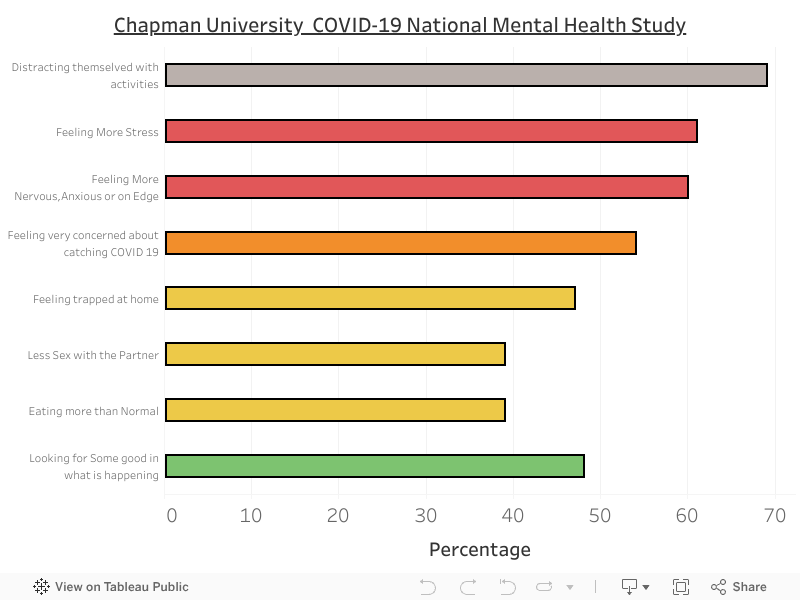
Chapman University conducted a study on different mental health impacts due to COVID based on a National Survey with 4149 respondents. The survey was basically to find out how American people are responding based on the COVID impact. Survey results found that most of the people felt additional stress and depression. Below visualization is based on the Chapman data. Visualization confirms majority of the people are affected with some or other mental perturbance.
Mental Health in USA
The Substance Abuse and Mental Health Services Administration (SAMHSA) is the agency within the U.S. Department of Health and Human Services that leads public health efforts to advance the behavioral health of the nation.National Mental Health Services Survey (N-MHSS) is an annual survey designed to collect statistical information on the services and characteristics of all known mental health treatment facilities across USA. In every other year, beginning in 2014, the survey also collects statistical information on the numbers and demographic characteristics of persons served in these treatment facilities as of a specified survey reference date.
Mental illness recovery in terms medication and therapy involves cost. Many of Amercans avoid it becasue of the costs involved out of pocket. As per AmericanProgress, in 2016, about 11.8 million Americans were not able to get Mental Health Services, out of which nearly 38 percent could not afford because of the cost involved.
Below are the Visualizations for the data collected between March 26, 2018 through November 30, 2018 which shows the percentage affected and percentage who really took some form of treatment.



Percent of People with Mental Health Issues

From the above Visualization, it is very evident that the people of young age is highly affected and middle age is moderately affected.
Another aspect which was interesting is Multi race and Whites are highly affected. I was wondering whether any cultural aspect of it is causation but did not have a data to prove of it is really a factor influencing it.
Women generally are more stressed which is proving that they need to manage both families and work more.
Percent of People with Mental Health Issues who underwent treatment

Above Visualization is quite contrary to the previous one. Young people are less interested in getting mental illness treated. It is the older people who are actively treating their mental illness. Probably young people are seeking other ways to cope up.
As mentioned previously, mental illness can also arise due to stressful life events. They can be in the form of Death of a loved one, Divorce, Marital separation, Major illness or injury, Job loss, Moving etc.
Below are some of the effects of Stressful life events on Mental Health.

Understood.. What next?
Everyone wants to live a healthy life free from any mental stress and other diseases but in this fast-moving world, unhealthy food, sedentary life, long working hours and less social life have affected many of the people with depression, anxiety and mental issues. This can be a big problem for our existence if it is not addressed properly.
As per Department of Health UK,Mental wellbeing includes factors such as individuals’ ability to develop their potential, work productively and creatively, build strong and positive relationships with others and contribute to their community. It is impractical for someone to feel good all of the time. Experiences of painful emotions such as failure, disappointment and grief are part of normal life. However, mental wellbeing is reduced when these emotions are very frequent, long lasting or very intense and interfere with a person’s ability to function in their daily life.
Tips to help you feel better
While medication in the form of antidepressants or anti-anxiety drugs is available for treating mental illness and improving mental health, there are other things we can do to promote healthy living complementary to medication. Here are some simple ways which you can implement in your life to make it much more fulfilling and free from mental problems thus elevating your mental and physical wellbeing.

Eating Healthy Diet
Eating right foods impacts positively on our mental health. Healthy diet can improve cognitive function and reduce symptoms of mental illness.
Parletta, N. et al. (2012) on their study found that a Mediterranean-style diet (a diet high in vegetables, fruits, legumes, nuts, beans, cereals, grains, fish, and unsaturated fats such as olive oil.) supplemented with fish oil led to a reduction in depression among the groups. Below are some foods good for mental well-being
- Fruits and vegetables
- Whole grains
- Cereals
- Beans and pulses
- Nuts and seeds
- Olive oil
- Fish oil
As per American Journal of Psychiatry, People who consume in whole foods such as fruits, vegetables, nuts, whole grains, legumes, fish and unsaturated fats (like olive oil) are up to 35% less likely to develop depression than people who eat less of these foods. As per Jacka FN, et al, young people with the healthiest diets are about half as likely to have depression compared to those who consume foods of high carbs and sugar.




Physical Activity
Another important aspect of our mental well-being is involving physical activity. Studies say regular Physical activity has a strong correlation to better mental well-being.
Physical activity can vary in terms of light, moderate and heavy workouts. Below are some of the Physical activities which have proven effects on the mental health of individuals.
- Walking
- Running
- Cycling
- Playing Sports
- Swimming
- Martial Arts
- Kickboxing
- Simple Exercises like Stretching
- Gardening
- Dancing
- Housework





Sleep
Sleep is important for the body to take rest and cease its function for a short duration. Without inadequate sleep, our mind and body will not be able to operate at their full potential. Sleep provides down time to the brain to energize itself from continuous processing.
With busy lives in the world now our average sleep quota is tremendously getting reduced. Sleep-deprivation has become a common problem nowadays.
Serotonin is an hormone produced by the brain that affects sleep. Serotonin deficiency are very likely to cause mental health problems like depression and anxiety. Levels of serotonin are highest in the brain when we are awake and active, and the brain produces more serotonin when it is lighter outside.
The necessary hours of sleep varies from person to person. Generally, for an average adult, Doctors recommended 7-8 hours of sleep. Children between 6 to 12 years of age 9-12 hours sleep is a must for their higher cognitive function. Researchers from the University of Warwick have found that depression, anxiety, and compulsive behaviour in children may be possible because of improper sleep pattern.


Impact of Sleep Deprivation on Mental Health and Anxiety

Yoga
Yoga has been in recent times popular maintaining physical health and mental health. stress-reduction techniques have been studied as possible treatments for depression and anxiety. One national survey estimated, for example, that about 7.5% of U.S. adults had tried yoga at least once, and that nearly 4% practiced yoga in the previous year.
Yoga classes can vary from gentle and accommodating to strenuous and challenging; the choice of style tends to be based on physical ability and personal preference. Hatha yoga, the most common type of yoga practiced in the United States, combines three elements: physical poses, called asanas; controlled breathing practiced in conjunction with asanas; and a short period of deep relaxation or meditation.
Yoga develops awareness in the thought process and makes mind to remain calm and composed in both unfavorable and favorable situations.
Meditation
Meditation, particularly mindful meditation, teaches those who practice it to focus on the present moment, breath by breath.
Meditation has been in practice for a long time. It was not popular across the world. Nowadays people are seeing the benefit of doing meditation because of a fast-paced stressful life. People are showing interest in winding down their mind and relax their body to get refreshed. Even a daily meditation of 15 mins have proven to calm down mental stress. According to Psychology today, meditation can help individuals sleep better, cope with some symptoms associated with mental disorders like depression and anxiety, reduce some of the psychological difficulties associated with chronic pain, and even improve some cognitive and behavioural functions.
Social Connection and asking support
Research has shown that social support wards off the effects of stress on depression, anxiety and other health problems. Social connectedness can be understood as ‘a subjective psychological bond that people feel in relation to individuals and groups of others’ (Haslam C. et al, 2015). Loneliness and socially disconnectedness are one of the main reasons for Depression.
As social beings, humans need valuable connections. It brings a sense of support and comfort to us and eliminates loneliness that can lead to mental health issues. According to Mental Health America, over 71% of people turn to their friends and family in time of stress. If sufficient support and guidance is not available with family/friends, it is always better to take counselling from a trained therapist to cope up.
Benefits of social connection
- Better emotional balance
- Sharing thoughts and Ideas which can inspire.
- Higher self esteem
- Bringing Empathy
- Less anxiety and depression
- Increased longevity of life






Final Thoughts
“You say you’re ‘depressed’ – all I see is resilience. You are allowed to feel messed up and inside out. It doesn’t mean you’re defective – it just means you’re human.”—David Mitchell
what can I do ?..
- Have a healthy diet
- Keep an active lifestyle
- Have sound sleep
- Practice Meditation and Mindfulness techniques
- Maintain Social interactions and Healthy relationship
- Provide support to your friends/relatives who have mental illness
Keep mental illness at bay..


Image credits
All images are sourced from unsplash for free personal use. However, I would like to thank the below contributors for their wonderful pictures.
Contributors : Zohre Nemati,Yuval Yehudar,Yannic Laderach,Tomas Gal, Toa Heftiba,Sharon Mccutcheon,Reza Hasannia,Priscilla Du Preez,Nik Shuliahin,Nadine Primeau,Naassom Azevedo,Le Minh Phuong,Christopher Campbell,Cade Renfroe,Bruce Mars,Ben White,Anthony Fomin
References
National Alliance of Mental Illness https://www.namigreenvillesc.org/what-is-mental-illness/
MentalHealth.gov https://www.mentalhealth.gov/basics/what-is-mental-health
Centers for Disease control and prevention https://www.cdc.gov/mentalhealth/index.htm
National Health Council https://nationalhealthcouncil.org/blog/mental-health-america-data-shows-impacts-of-covid-19-on-mental-health/
Conway, M., & O'Connor, D. (2016). Social Media, Big Data, and Mental Health: Current Advances and Ethical Implications. Current opinion in psychology, 9, 77–82. https://doi.org/10.1016/j.copsyc.2016.01.004 https://www.ncbi.nlm.nih.gov/pmc/articles/PMC4815031/
National Institute of Mental Health https://www.nimh.nih.gov/health/statistics/mental-illness.shtml
Substance Abuse and Mental Health Services Administration https://www.samhsa.gov/data/report/2018-nsduh-annual-national-report
Edmunds, Sarah; Biggs, Hannah; Goldie, Isabella . (2013). Lets Get Physical. Retrieved from https://www.mentalhealth.org.uk/sites/default/files/lets-get-physical-report.pdf
Eaklor, B. (2018, April 22). How to Stay Positive When You Are Depressed . Retrieved from https://www.healthyplace.com/blogs/toughtimes/2018/04/how-to-stay-positive-when-you-are-depressed
Krull, E. (2018, October 8). Social Support Is Critical for Depression Recovery. Retrieved from https://psychcentral.com/lib/social-support-is-critical-for-depression-recovery/
Bélair MA, Kohen DE, Kingsbury M, Colman I. Relationship between leisure time physical activity, sedentary behaviour and symptoms of depression and anxiety: evidence from a population-based sample of Canadian adolescents. BMJ Open. 2018 Oct 17;8(10):e021119. doi: 10.1136/bmjopen-2017-021119. PMID: 30337306; PMCID: PMC6196847.
Jacka FN, et al. A prospective study of diet quality and mental health in adolescents. (2011). PLOS One. 6(9):e24805.
Parletta, N., Zarnowiecki, D., Cho, J., Wilson, A., Bogomolova, S., Villani, A., Itsiopoulos, C., Niyonsenga, T., Blunden, S., Meyer, B., Segal, L., Baune, B. and O’Dea, K. (2017). A Mediterranean-style dietary intervention supplemented with fish oil improves diet quality and mental health in people with depression: A randomized controlled trial (HELFIMED). Nutritional Neuroscience, pp.1-14.
https://www.health.harvard.edu/mind-and-mood/yoga-for-anxiety-and-depression
https://www.psychologytoday.com/us/blog/balanced/201907/meditation-and-mental-health
Data Sources
CDC - https://data.cdc.gov/
SAMHSA- https://www.datafiles.samhsa.gov/
BMJ OpenData https://www.bmj.com/open-data
 Built with Shorthand