
Representation of Women Artists
In Major U.S. Art Museums

"...if there are no great celebrated women artists, that's because the powers that be have not been celebrating them, but not because they are not there."
The Gender Gap in the Art World: Representation vs. Reality
According to a report by the National Endowment for the Arts in 2015, 80,360 bachelor’s degrees in fine and performing arts were awarded. Of these, women earned approximately 70 percent of fine arts degrees. This figure is especially notable given that the percentage of women earning bachelor’s degrees in the arts was five percentage points higher than the overall average for female bachelor’s degree recipients that year.
Despite these statistics, only 46 percent of working artists across all artistic disciplines are women. The disparity becomes even more apparent when examining women artists featured in major U.S. art museums. In 2019, an analysis of the permanent collections of 18 prominent museums found that 87 percent of the works were by male artists.
This lack of representation is not due to a lack of participation but rather to systemic inequality in the art world. To better understand the scope of the problem, this page analyzes statistics from 1980 to 2019, examining various aspects of the art world, such as art acquisitions, permanent collections, and the representation of women artists in major U.S. museums. Additionally, the page highlights advocacy efforts, from the Guerrilla Girls' 1989 billboard campaign to the National Museum of Women in the Arts’ #5WomenArtists online movement. Both of which have aimed to raise awareness about gender disparity in art institutions. The page concludes with a call to action and provides information on how to get involved in the movement.
A Timeline of Gender Disparity in the Art World
For decades, artists and activists have worked to expose the overwhelming gender imbalance in art institutions. Despite women earning the majority of fine arts degrees, they remain significantly underrepresented in museum collections, exhibitions, and gallery spaces.
While individual artists and institutions have made strides in advocating for change, the numbers tell a different story—one of continued exclusion and systemic barriers.
This timeline highlights key moments in the fight for gender equity in art institutions, from the founding of the National Museum of Women in the Arts to activist campaigns that exposed stark disparities and the first large-scale study on museum diversity. Each event underscores a pivotal fact that shaped public discourse and called for institutional change.
As you move through the timeline, consider how these efforts have (or haven’t) shifted the landscape. The next section will provide visualizations to illustrate trends over time before leading to a final call to action.
1987
National Museum of Women Artists
After traveling through Europe, Wilhelmina Holladay and her husband, Wallace F. Holladay, turned to H.W. Janson’s History of Art to learn more about Flemish painter Clara Peeters. To their surprise, the book made no mention of Peeters—or any other female artists. This glaring omission led them to establish the National Museum of Women in the Arts (NMWA), which opened to the public in April 1987. It became the world’s first museum dedicated to celebrating the achievements of women artists across all periods and nationalities by exhibiting, preserving, and acquiring their work.
1989
Do women have to be naked to get into the Met Museum?
The feminist activist group Guerrilla Girls launched a poster campaign across New York City with the provocative question: “Do women have to be naked to get into the Met Museum?” The campaign stemmed from their discovery that while fewer than 5% of the artists in the museum’s Modern Art section were women, 85% of the nude artworks depicted women.
2004
Guerilla Girls Reissues Campaign
As the new millennium began, little had changed. In 2004, the Guerrilla Girls once again counted the number of women artists in the Met Museum’s Modern Art section. This time, they found that only 4% of the artists were women. That same year, the activist group published The Guerrilla Girls’ Art Museum Activity Book, a satirical yet educational guide to gender disparities in the art world.
2012
Third Time’s the Charm? Women’s Representation Declines Further
The Guerrilla Girls reissued their iconic campaign, “Do women have to be naked to get into the Met Museum?”—this time revealing that in 2012, fewer than 3% of the artists in the museum’s Modern Art section were women. This meant that from 1989 to 2012, women’s representation in the Modern Art section had actually decreased. That same year, the campaign expanded to highlight gender disparities in other institutions. For example, a poster targeting the Boston Museum of Fine Arts revealed that only 11% of its artists were women.
2015
Pussy Galore’s Report Card Exposes Gallery Inequality
Inspired by the Guerrilla Girls, the feminist art collective Pussy Galore evaluated gender representation in major New York galleries. They presented their findings as a "report card" to illustrate how poorly these galleries performed. The lowest score went to the Tony Shafrazi Gallery, where only 5% of the represented artists were women, while the highest score (64%) went to Galerie Lelong. Although the numbers showed a slight improvement compared to the 1986 report card, the findings made it clear that galleries had done little to address gender disparities since the 1980s. Additionally, the fact that Pussy Galore had to manually count the artists underscored a larger issue: even in 2015, there was no comprehensive dataset analyzing gender inequality in the art world.
2016
#5WomenArtists
In 2016, the National Museum of Women in the Arts launched the award-winning #5WomenArtists social media campaign for Women’s History Month by posing a simple yet revealing question: Can you name five women artists? For many, the question proved challenging, highlighting the persistent underrepresentation of women in museums, galleries, and auction houses. Since then, the campaign has grown, with over a thousand cultural organizations and countless individuals participating annually by sharing events, media, and resources that promote gender equity in the arts.
2019
First Large-Scale Study on Museum Diversity (Topaz et al.)
Until this point, the diversity of artists in U.S. art museums had gone largely unexamined. While individual museums like MoMA and the Tate Collection had begun publishing datasets of the artists in their collections, no large-scale study compared representation across multiple institutions. That changed in 2019 when Topaz et al. conducted the first comprehensive analysis of diversity in major U.S. museums. By examining public online catalogs from 18 major institutions, the researchers compiled records of 10,000 artists. Using crowdsourcing methods, they inferred the artists' genders, ethnicities, geographic origins, and birth decades. Their findings were alarming, as they revealed a stark disconnect between museums' stated missions and the actual diversity of their collections.
Tracing the Numbers: Why Data Matters in the Fight for Equity
The Topaz et al. study quantified what had long been recognized—women artists are significantly underrepresented in art museums. The study found that in the permanent collections of 18 prominent museums, 87 percent of the works were by male artists. When looking at specific numbers, the disparity becomes even clearer. For example, at the National Gallery of Art, only 10.4 percent of the 336 artists in their permanent collection are women (35 in total).
In response to these findings, some museums have made efforts to bring greater gender parity to their permanent collections, but progress has been slow. According to the Burns Halperin Report published in 2022, between 2008 and 2020, only 11 percent of acquisitions at U.S. museums were works by women artists. During this same period, just 3.2 percent of global auction sales were for works by women. Even record-breaking sales highlight the imbalance: in 2019, Jenny Saville’s Propped (1992) became the most expensive work sold at auction by a living female artist, fetching $12.5 million—less than 14 percent of the record for a living male artist, Jeff Koons, whose Rabbit (1986) sold for $91.1 million.

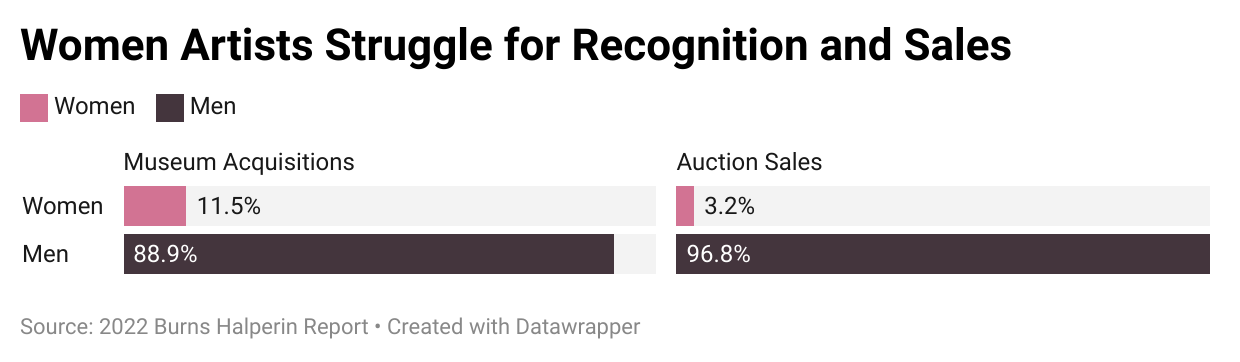
This stark imbalance raises critical questions about whose work museums prioritize and preserve. The Topaz et al. report further reveals that the majority of women artists in permanent collections were born between the 1930s and 1970s, mirroring trends seen for male artists.
However, closer examination suggests a troubling pattern: a small number of women dominate both museum exhibitions and auction sales. In fact, just five women artists account for $1.6 billion of the $4 billion spent globally on women’s art over the past 11.5 years. In contrast, auction sales for male artists are distributed more equitably, with the top five male artists accounting for only 8.7 percent of total sales.

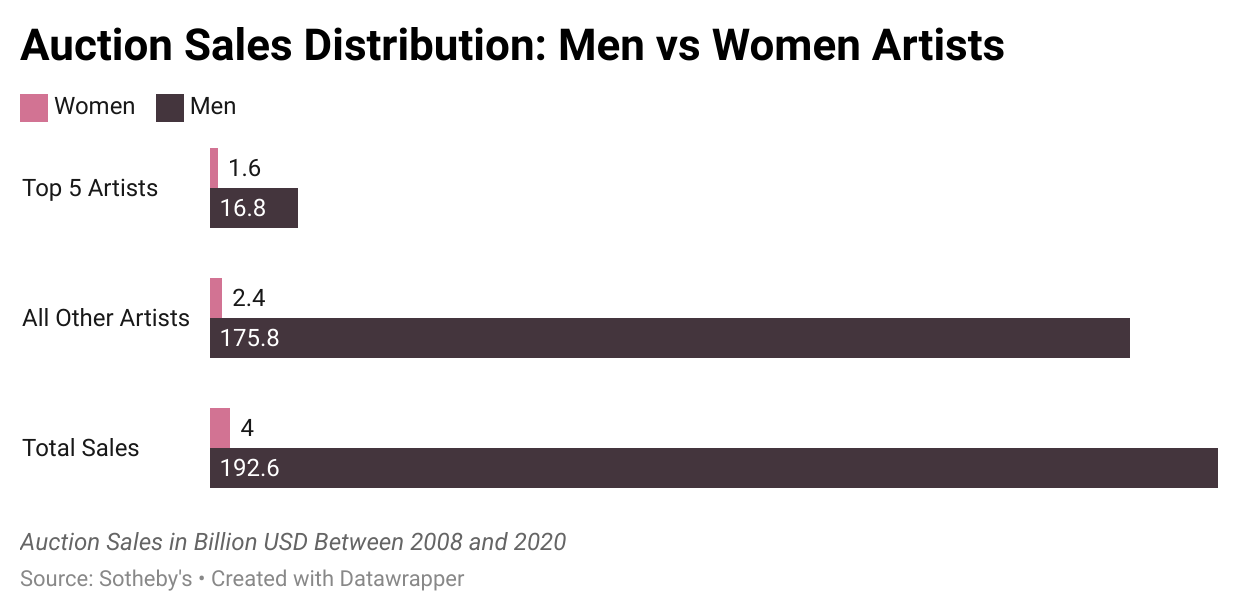
These figures underscore a persistent and systemic issue—women artists are not only underrepresented but also undervalued in the art market and museum spaces. This limited recognition affects the visibility of emerging women artists, influences funding opportunities, and perpetuates the historical exclusion of women from artistic institutions. Addressing these disparities requires action. The next section highlights the importance of exploring current exhibitions showcasing women artists.
“Art is not a privilege, it’s a right. It’s a fundamental part of being human.”
Carmen Lomas Garza
Take Action:
Support Women Artists in Museums
The underrepresentation of women artists in museums, galleries, and the art market is a systemic issue—but change is possible with awareness and collective action. Amplifying the voices of women artists helps drive progress, and one of the most powerful ways to do this is by actively seeking out and celebrating their work. When we engage with and support exhibitions featuring women artists, we send a clear message to the art world that their work deserves greater visibility.
To explore women-led exhibitions near you, click below.
To experience online exhibitions, click below.
Beyond visiting, you can also help elevate women artists by sharing your experiences on social media, encouraging others to attend, and engaging with museums and galleries to express your support for gender-equitable exhibitions.
By making a conscious effort to engage with and promote women’s art, we can help close the gender gap in museums and beyond. The fight for equity in the arts is ongoing, but each visit, post, and conversation contributes to a future where all artists receive the recognition they deserve.
Let’s continue pushing forward -
one exhibition at a time.



References
About #5WomenArtists | National Museum of Women in the Arts. (2025, February 13). National Museum of Women in the Arts. https://nmwa.org/support/advocacy/5womenartists/
Artists and other Cultural Workers: A statistical portrait. (n.d.). National Endowment for the Arts. https://www.arts.gov/impact/research/publications/artists-and-other-cultural-workers-statistical-portrait
BOOKS — Guerrilla girls. (n.d.). Guerrilla Girls. https://www.guerrillagirls.com/books
Burns, C., & Halperin, J. (2020, August 27). Female artists represent just 2 percent of the market. Here’s why—and how that can change | Contemporary Art | Sotheby’s. Sothebys.com. https://www.sothebys.com/en/articles/female-artists-represent-just-2-percent-of-the-market-heres-why-and-how-that-can-change
Burns, C., & Halperin, J. (n.d.). Letter from the editors: Introducing the 2022 Burns Halperin Report – Burns Studio. https://studioburns.media/letter-from-the-editors/
Fact Sheet | National Museum of Women in the Arts. (2023, December 13). National Museum of Women in the Arts. https://nmwa.org/fact-sheet/
Guerrilla Girls | Do women have to be naked to get into the Met. Museum? | The Metropolitan Museum of Art. (1989). The Metropolitan Museum of Art. https://www.metmuseum.org/art/collection/search/849438
Morales Gomez, D., & Flock, E. (2017, March 30). Few people can name five female artists — can you? PBS News. https://www.pbs.org/newshour/arts/people-can-name-five-female-artists-can
#5WomenArtists. (n.d.). ArtGirlRising. https://artgirlrising.com/pages/5womenartists
 Built with Shorthand