
From Print to Picture
Analyzing the Impact of Book-to-Movie Literary Adaptations
By Natasha Pawar


Book-to-movie adaptations have been a cornerstone of the entertainment industry, offering financial and cultural benefits for many years. These adaptations often bring a built-in audience, resulting in strong box office performance and increased book sales. This report examines the economic effects of book adaptations, the box office performance of adapted films, popular franchises, and their potential to achieve global appeal. It also emphasizes some key challenges in the industry, such as the disproportionately low compensation provided to authors for their work and the backlash adapted works can receive when they stray too far from source material. This report seeks to inform stakeholders in both industries on equitable practices for adapting literary works into films, ensuring benefits for all stakeholders involved, while captivating audiences using data-driven insights.


Photo by Florian Klauer on Unsplash
Photo by Florian Klauer on Unsplash
Chapter 1
The Set Up
An Introduction to Book-to-Movie Adaptations





Photo by Jeremy Yap on Unsplash
Photo by Jeremy Yap on Unsplash

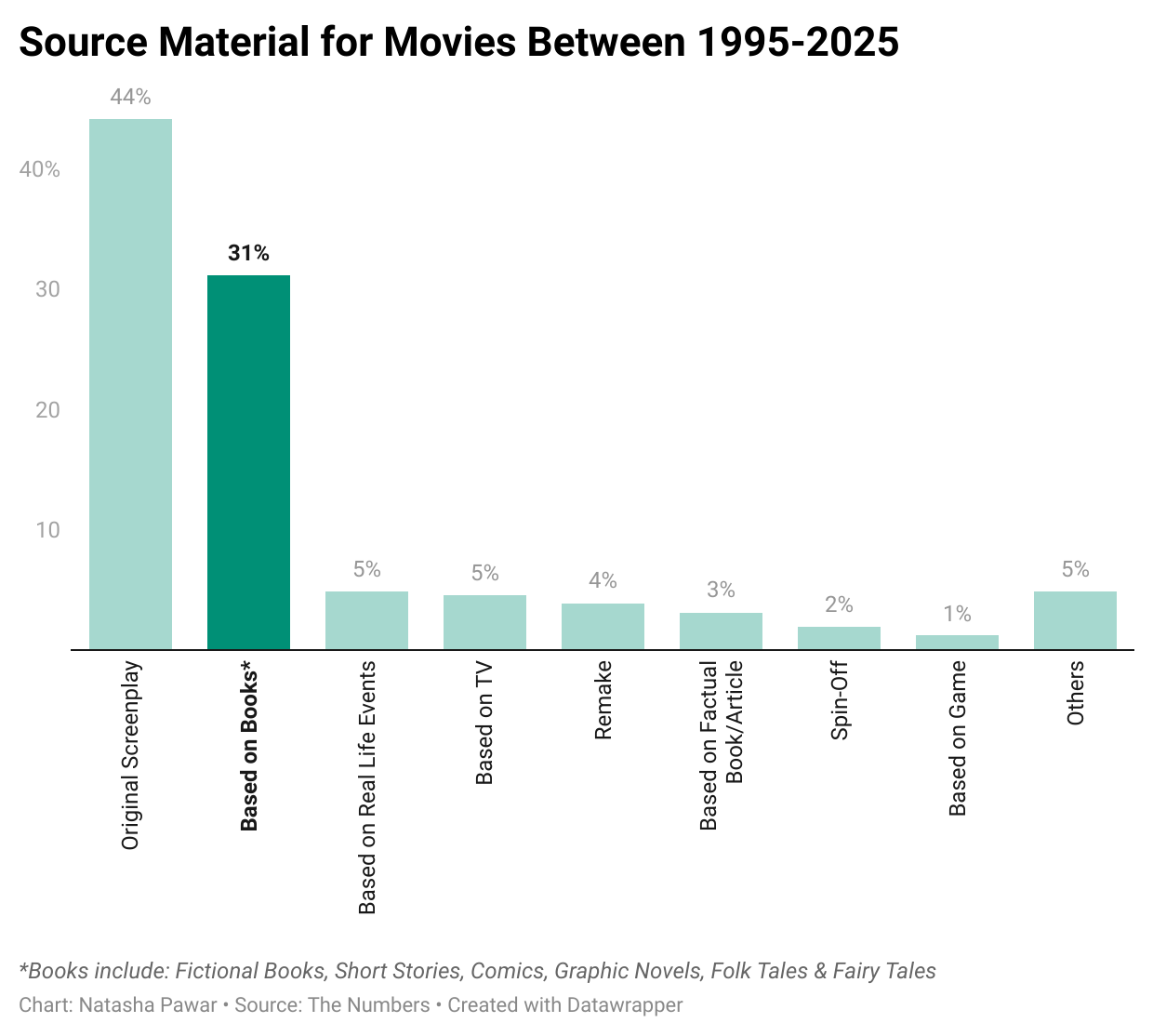
Book adaptations offer filmmakers and producers ready-made narratives with pre-existing fan bases. This has been one of the leading reasons for production houses to develop adapted content instead of creating original in-house content; it is less risky and there is significantly lesser investment required for brand building and marketing purposes (Why Hollywood Is Turning to Books for Its Biggest Productions | The Verge, n.d.). These adaptations have proven to provide financial success, and further provide indirect benefits to both the source material and films, in the form of increased books sales and box office success, ultimately often outweighing the heavy costs involved. This trend is apparent in streaming content as well.
The Process of Adaptation
The journey from page to screen involves multiple steps. These include:
1. Acquisition of Rights: Production studios negotiate with publishers and authors to obtain adaptation rights, at varying costs.
2. Screenplay Development: The source material is condensed or modified into a screenplay format, which may involve altering story arcs and characters for cinematic and visual appeal.
3. Production & Marketing: The film is then produced, marketed, and distributed, with adaptations often leveraging book popularity in promotional strategies.
Data from The Numbers suggests that between 1995 and 2025, the second leading source of box office revenue comes from movies that have been derived and adapted from books, at a grand total of 31% (Sources Movie Breakdown 1995-2025, n.d.). Furthermore, recent trends indicate that majority of these adaptations are primarily in the YA and contemporary genre (Why Hollywood Is Turning to Books for Its Biggest Productions | The Verge, n.d.).
Chapter 2
The Film Industry
How Adaptations Impact Box Office Performance & Result in Global Penetration


Adaptations have consistently shown their ability to outperform original screenplays in terms of annual revenue generation at the box office. The pre-existing audience from a book’s readership often provides an strong foundation, making these films a safer investment for studios. Additionally, adaptations of well-loved franchises tend to have strong opening weekends due to fan anticipation and pre-existing brand recognition.
In many cases, the profitability of adaptations surpasses that of original works. Films such as Harry Potter and The Hunger Games have demonstrated that adaptations can generate returns far exceeding their production budgets. The financial success of these films is often fuelled by multi-film franchises, which keep audiences engaged over several years and maintain steady revenue streams for studios. Between 2012 and 2024, the annual domestic box office of each respective year included a literary book to movie adaptation in 7 of 13 years and a comic book/graphic novel to movie adaptation 12 out of 13 years (The Numbers, n.d.). This indicates that these adapted works are highly profitable revenue streams for production houses and can lead to immense success domestically.
In addition to this, licensing and merchandising opportunities also significantly add to revenue, as seen with Harry Potter’s expansive merchandise empire, from toys and theme parks to spin-off franchises like Fantastic Beasts (Book Adaptations on the Rise as Studios Consider Them a Safer Bet | 3Vision, n.d.).


Photo by Pyae Sone Htun on Unsplash
Photo by Pyae Sone Htun on Unsplash
Global Success
Adaptations not only perform well domestically but also often find major success in international markets. The global appeal of literary works and their global reach allows studios to tap into audiences across the globe, further boosting revenue. According to The Numbers, The Lord of the Rings trilogy, for example, generated over 70% of its earnings from international box office sales alone, demonstrating the widespread appeal of high-quality literary adaptations (Peter Jackson’s Lord of the Rings Franchise Box Office History, n.d.). In fact, as of January 2025, out of the 20 highest grossing movie franchises, 15 of them are adapted from books (Movie Franchises - Box Office History, n.d.). This further demonstrates that adaptations with universal themes or beloved characters can often find success in multiple language markets.

Photo by Aditya Vyas on Unsplash
Photo by Aditya Vyas on Unsplash
Streaming platforms have also amplified the reach of book adaptations, enabling global audiences to engage with adaptations regardless of geographic constraints. Netflix’s adaptation of The Witcher, became a big hit due to the international popularity of the book series, further emphasizing how adaptations can thrive in a globalized entertainment landscape (10 Top Book-To-Screen TV And Film Adaptations On Netflix, n.d.).
Chapter 3
The Publishing Industry
The Indirect Impact on Books Sales & Strategies for Mutual Gain



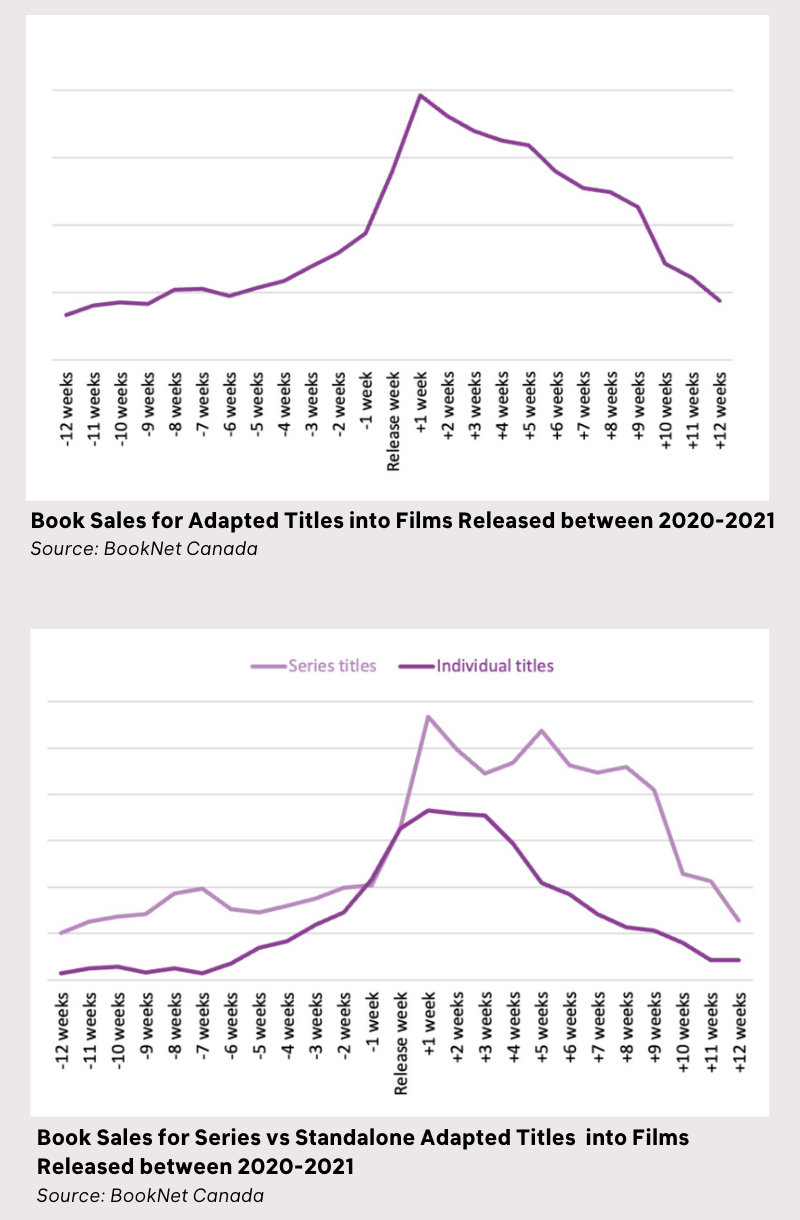
Successful franchises also provide a return to the source content. When adaptations release, they often reinvigorate interest in the books, leading to significant spikes in book sales. These spikes are seen throughout the adaptation process, from when the movie and casting is announced, teasers and trailers released, all the way till the release of the movie. According to data from BookNet Canada studying 60 adapted film titles released between 2020 to 2021, there was a 307% increase in sales for books between 12 weeks prior to a movie release to 1 week post release (Must-Watch, Must-Read, 2022a).
Books are also often adapted to television shows. Since 2016, according to 3Vision, more than 70% of Netflix's SVOD original titles have been adapted works (Book Adaptations on the Rise as Studios Consider Them a Safer Bet | 3Vision, n.d.). These shows have similar results on book sales. According to data from BookNet Canada studying 30 adapted film titles released between 2020 to 2021, there was a 979% increase in sales for books between 12 weeks prior to a movie release to 1 week post release (Must-Watch, Must-Read, 2022a).
This effect is particularly pronounced in fiction (42%) and young adult fiction (32%), particularly for book series, where readers often seek to experience the original story before or after watching the adaptation (Must-Watch, Must-Read, 2022a). For example, following the release of the Dune film, book sales for the first book of the series surged by 153%, according to the same data set by BookNet Canada, demonstrating the direct impact of adaptations on the publishing industry (Must-Watch, Must-Read, 2022b). These trends are also apparent in library circulation. Similarly, the Harry Potter series saw renewed book sales after each movie release, and topped the New York Times Bestselling charts, solidifying its place as one of the best-selling book series of all time (The Book That Started It All: Celebrating 25 Years of “Harry Potter and the Philosopher’s Stone,” n.d.).
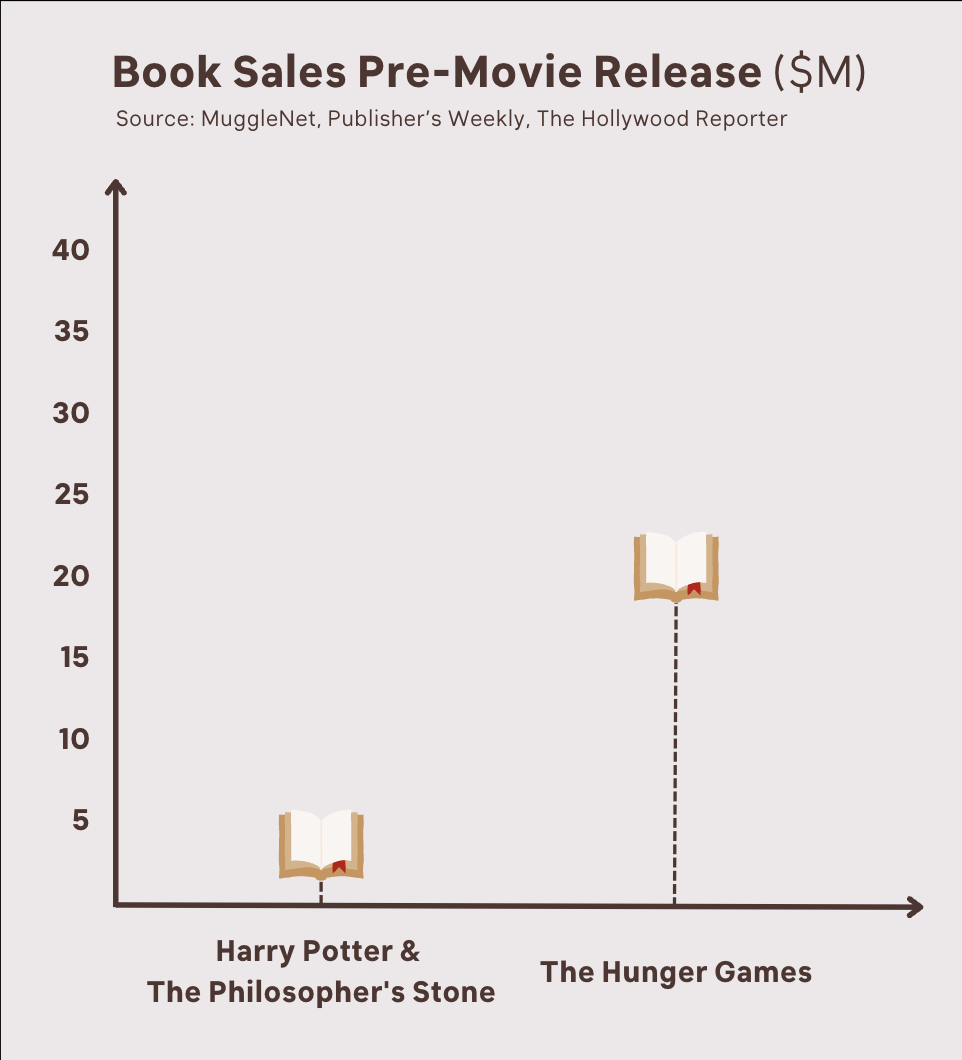
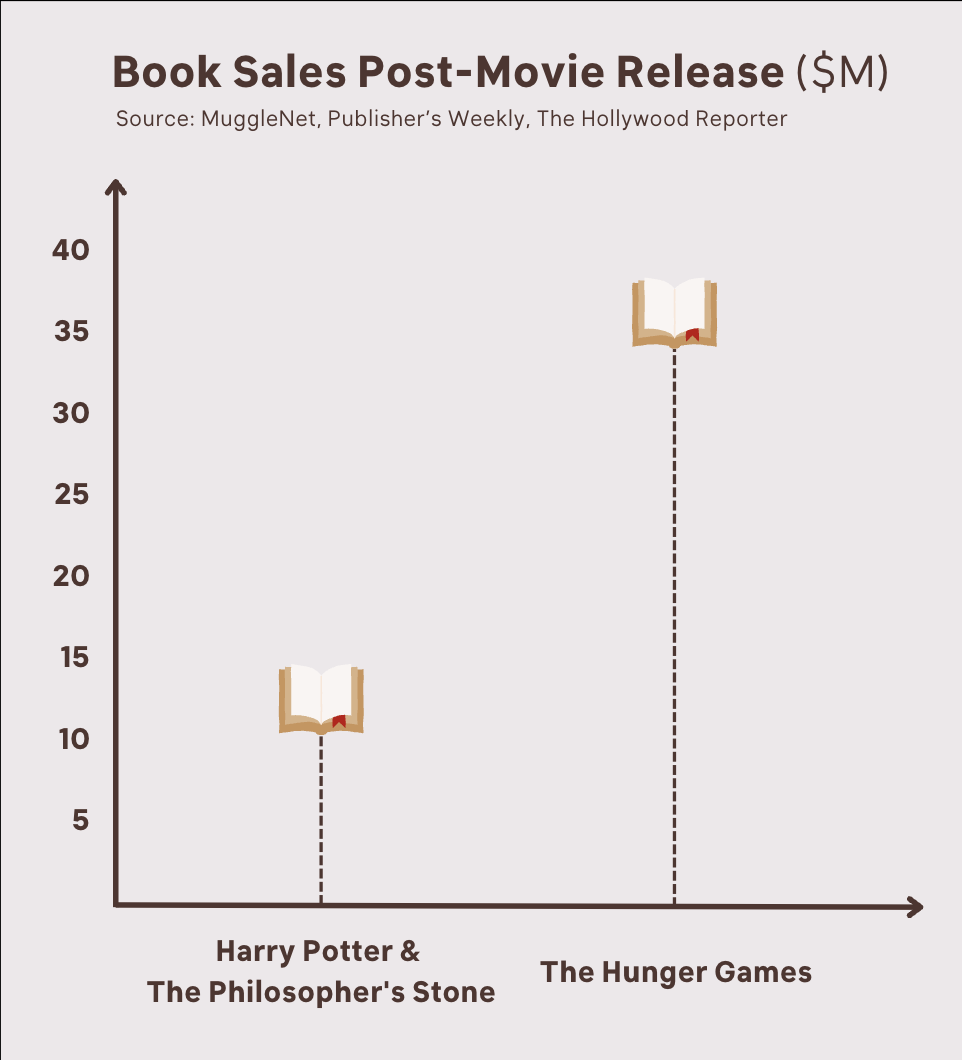
Hunger Games and Harry Potter & The Philosopher's Stone particularly saw massive surges in book sales particularly from one year prior to the release of the movie to immediately after. This trend can be seen for most YA titles (Lewis, 2012) (The Book That Started It All: Celebrating 25 Years of “Harry Potter and the Philosopher’s Stone,” n.d.).
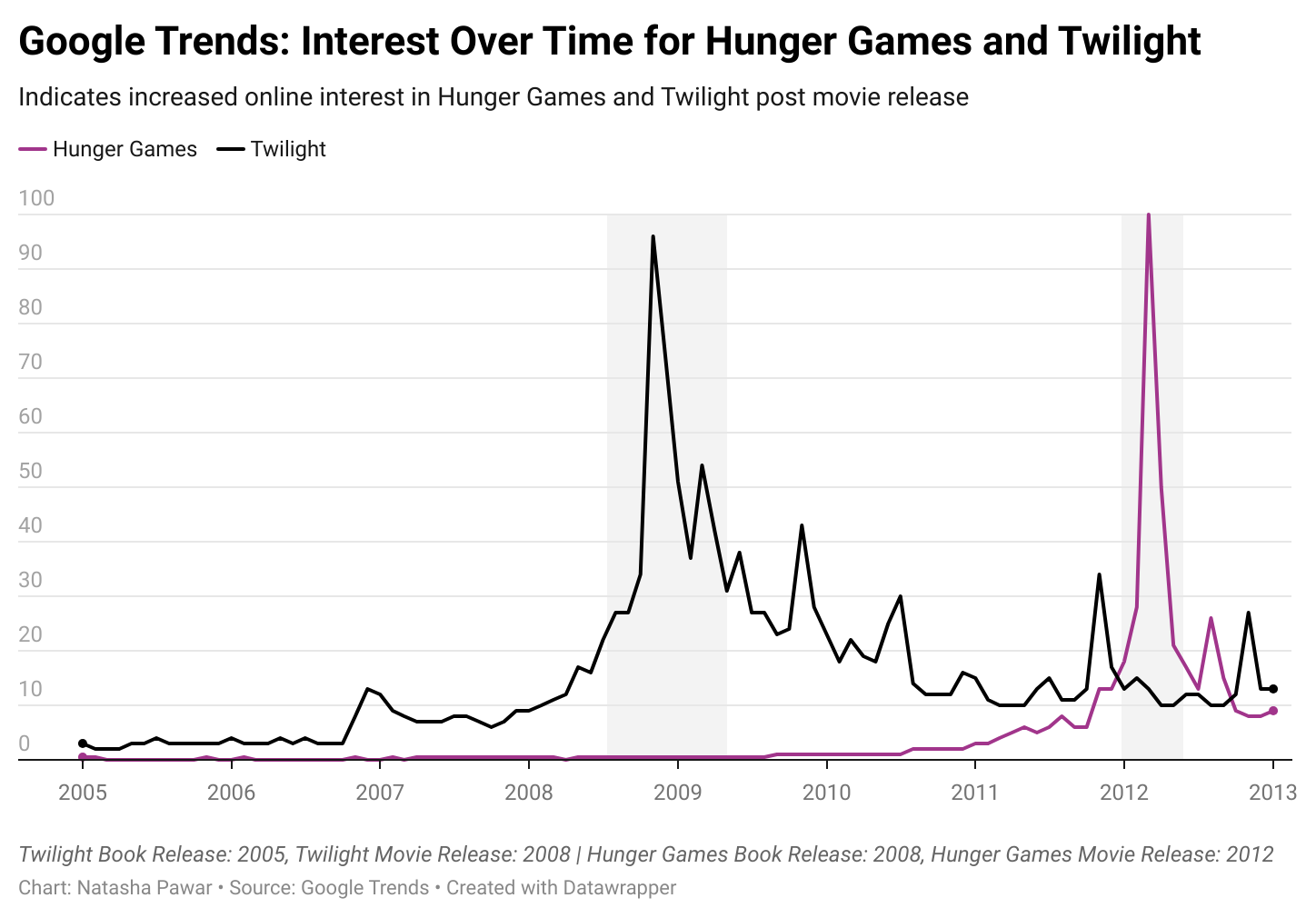
There is considerable data that supports this concept, with regard to the creation of "buzz" during the time of a book adaptation being released. Twilight and Harry Potter, both mega YA franchises saw surges in online interest and engagement, with conversation, defined by the percent of messages at an all time high. Further data from Google Trends also supports this phenomenon. There was a huge spike in searches according to Google Trends data for "Hunger Games" post the release of the film in 2008, once again illustrating the interest and audience engagement.
For publishers, these adaptations present a golden opportunity to repackage and remarket books to new audiences. Common strategies include special edition covers featuring movie branding, re-releases with additional content, and bundled book sets that capitalize on an adaptation’s success. Additionally, book sales can see extended longevity in the market, as fans continue engaging with the literary source long after the film’s release.
Hunger Games and Harry Potter & The Philosopher's Stone particularly saw massive surges in book sales particularly from one year prior to the release of the movie to immediately after. This trend can be seen for most YA titles.
There is considerable data that supports this concept, with regard to the creation of "buzz" during the time of a book adaptation being released. Twilight and Harry Potter, both mega YA franchises saw surges in online interest and engagement, with conversation, defined by the percent of messages at an all time high. Further data from Google Trends also supports this phenomenon. There was a huge spike in searches according to Google Trends data for "Hunger Games" post the release of the film in 2008, once again illustrating the interest and audience engagement.

Long Term Impact
Beyond the immediate sales surge, adaptations also contribute to the longevity of a book’s influence. Successful adaptations often lead to increased readership for an author’s entire body of work, benefiting both established and lesser-known writers. For instance, J.R.R. Tolkien’s The Lord of the Rings saw a renewed global readership decades after its publication after Peter Jackson’s acclaimed film trilogy (Book Adaptations on the Rise as Studios Consider Them a Safer Bet | 3Vision, n.d.). Similarly, the popularity of The Handmaid’s Tale television adaptation reignited interest in Margaret Atwood’s work, leading to the release of a long-awaited sequel (Press, 2019).
However, despite their work serving as the foundation for successful adaptations, the financial rewards for authors tend to be minimal in comparison to the substantial revenue generated by the films. This raises concerns about fairness in the distribution of profits and underscores the need for more equitable compensation models that better reflect the value authors bring to the table. Authors typically receive payments between $500 and $5,000 for option agreements, which grant production companies the right to adapt their work within a specific timeframe regardless of whether the adaptation is made or not (Shannon, 2021). After this, if the adaptation moves forward, authors generally receive 2-3% of the production budget as a purchase price (Shannon, 2021). While publishers try to negotiate residuals, they often receive nothing once the film is released (Shannon, 2021). This creates a significant imbalance, as authors contribute the original content that serves as the foundation for the adaptation, yet their financial reward does not reflect the long-term profits generated by the film. This discrepancy highlights the need for more equitable agreements that better compensate authors for the value their work adds to successful adaptations.



Chapter 5
Next Steps
What's can you do to support the industry?



Challenges in the Adaptation Process
It can be a tricky balance to achieve: straying too far from the books can alienate fans, while staying too close may limit cinematic storytelling potential. As an avid reader and consumer of adapted content, I can respect when narrative adjustments are necessary, but as a fan it can also be frustrating when there are major deviations in content. However, this can be accounted for; to maximize the success of book-to-movie adaptations, studios and publishers must adopt strategies that prioritize financial return and artistic integrity. Successful adaptations tend to have a few key factors in common:
- Author’s Direction: Many successful adaptations have the author of the source content part of the screenwriting, casting, and production process. This allows the intention and core themes of the story to remain intact, and can also bring a sense of authenticity to the body of work.
- Fidelity to Source Material: It can be critical to stay true to and respect the book’s main ideas, themes, and characters to ensure adequate support from the pre-existing fan base, while still having enough context on fan theories, issues in the fandom, and areas that can be updated or rectified.
- Strategic Marketing Campaigns: A symbiotic relationship can also be developed if book re-releases, special editions, and promotional efforts are synchronized with film premieres, to enhance audience engagement and “buzz” to garner interest.
Being in a position of power in the industry, many things can be done to prioritize these strategies. As organizations, executives can register to join and support the Author’s Guild and the Independent Film & Television Alliance to demand equal pay and fair industry practices in the development of adapted works.


References
“10 Top Book-To-Screen TV And Film Adaptations On Netflix.” Accessed February 10, 2025. https://www.forbes.com/sites/danafeldman/2024/05/10/here-are-the-top-10-book-to-screen-tv-and-film-adaptations-on-netflix/.
“All-Time Bestselling Children’s Books.” Accessed February 20, 2025. https://www.publishersweekly.com/pw/print/20011217/28595-all-time-bestselling-children-s-books.html.
“Book Adaptations on the Rise as Studios Consider Them a Safer Bet | 3Vision.” Accessed February 10, 2025. https://www.3vision.tv/news-insights/book-adaptations-on-the-rise-as-studios-consider-them-a-safer-bet.
BookNet Canada. “Must-Watch, Must-Read: And More about Media Tie-Ins,” June 28, 2022. https://www.booknetcanada.ca/blog/research/2022/6/28/must-watch-must-read-and-more-about-media-tie-ins.
BookNet Canada. “Must-Watch, Must-Read: The Dune Effect,” June 9, 2022. https://www.booknetcanada.ca/blog/research/2022/6/9/must-watch-must-read-the-dune-effect.
Google Trends. “Google Trends.” Accessed February 28, 2025. https://trends.google.com/trends/explore?date=2005-01-01%202013-01-01&geo=US&q=hunger%20games,twilight&hl=en.
Lewis, Andy. “‘Hunger Games’ Movie Fuels Sharp Rise in Book Sales.” The Hollywood Reporter (blog), March 28, 2012. https://www.hollywoodreporter.com/news/general-news/hunger-games-twlight-book-sales-versus-jennifer-lawrence-josh-hutcherson-305457/.
MuggleNet. “The Book That Started It All: Celebrating 25 Years of ‘Harry Potter and the Philosopher’s Stone.’” MuggleNet (blog), June 28, 2022. https://www.mugglenet.com/2022/06/the-book-that-started-it-all-celebrating-25-years-of-harry-potter-and-the-philosophers-stone/.
Nielsen. “Harry Potter Wizard of All Media vs. Twilight Vampire.” Accessed February 20, 2025. https://www.nielsen.com/insights/2009/harry-potter-wizard-of-all-media-vs-twilight-vampire/.
Press, Hillel Italie-The Associated. “Sales for ‘Handmaid’s Tale’ Sequel Top 125,000 Copies.” CTVNews, September 13, 2019. https://www.ctvnews.ca/lifestyle/entertainment/article/sales-for-handmaids-tale-sequel-top-125000-copies/.
Rowe, Adam. “Report: Film Adaptations Of Books Earn 53% More At The Worldwide Box Office.” Forbes. Accessed February 20, 2025. https://www.forbes.com/sites/adamrowe1/2018/07/11/why-book-based-films-earn-53-more-at-the-worldwide-box-office/.
Shannon. “How Much Do Book Authors Receive for Film Rights?” BeverlyBoy Productions (blog), June 17, 2021. https://beverlyboy.com/film-schools/how-much-do-book-authors-receive-for-film-rights/.
———. “How Much Do Book Authors Receive for Film Rights?” BeverlyBoy Productions (blog), June 17, 2021. https://beverlyboy.com/film-schools/how-much-do-book-authors-receive-for-film-rights/.
Statista. “World’s Highest-Grossing Movie Franchises as of 2025.” Accessed February 20, 2025. https://www-statista-com.us1.proxy.openathens.net/statistics/317408/highest-grossing-film-franchises-series/.
The Numbers. “Harry Potter Franchise Box Office History.” Accessed February 19, 2025. https://www.the-numbers.com/movies/franchise/Harry-Potter.
The Numbers. “Hunger Games Franchise Box Office History.” Accessed February 19, 2025. https://www.the-numbers.com/movies/franchise/Hunger-Games.
The Numbers. “Movie Franchises - Box Office History.” Accessed February 28, 2025. https://www.the-numbers.com/movies/franchises.
The Numbers. “Peter Jackson’s Lord of the Rings Franchise Box Office History.” Accessed February 28, 2025. https://www.the-numbers.com/movies/franchise/Peter-Jacksons-Lord-of-the-Rings.
The Numbers. “Sources Movie Breakdown 1995-2025.” Accessed February 28, 2025. https://www.the-numbers.com/market/sources.
The Numbers. “The Numbers - Movie Market Summary for Year 2001.” Accessed February 19, 2025. https://www.the-numbers.com/market/2001/summary.
The Numbers. “The Numbers - Movie Market Summary for Year 2012.” Accessed February 19, 2025. https://www.the-numbers.com/market/2012/summary.
The Numbers. “The Numbers - Movie Market Summary for Year 2012.” Accessed February 21, 2025. https://www.the-numbers.com/market/2012/summary.
The Numbers. “The Numbers - Movie Market Summary for Year 2013.” Accessed February 21, 2025. https://www.the-numbers.com/market/2013/summary.
The Numbers. “The Numbers - Movie Market Summary for Year 2014.” Accessed February 21, 2025. https://www.the-numbers.com/market/2014/summary.
The Numbers. “The Numbers - Movie Market Summary for Year 2015.” Accessed February 21, 2025. https://www.the-numbers.com/market/2015/summary.
The Numbers. “The Numbers - Movie Market Summary for Year 2016.” Accessed February 21, 2025. https://www.the-numbers.com/market/2016/summary.
The Numbers. “The Numbers - Movie Market Summary for Year 2017.” Accessed February 21, 2025. https://www.the-numbers.com/market/2017/summary.
The Numbers. “The Numbers - Movie Market Summary for Year 2018.” Accessed February 21, 2025. https://www.the-numbers.com/market/2018/summary.
The Numbers. “The Numbers - Movie Market Summary for Year 2019.” Accessed February 21, 2025. https://www.the-numbers.com/market/2019/summary.
The Numbers. “The Numbers - Movie Market Summary for Year 2020.” Accessed February 21, 2025. https://www.the-numbers.com/market/2020/summary.
The Numbers. “The Numbers - Movie Market Summary for Year 2022.” Accessed February 21, 2025. https://www.the-numbers.com/market/2022/summary.
“The Numbers - Movie Market Summary for Year 2021.” Accessed February 21, 2025. https://www.the-numbers.com/market/2021/summary.
“The Numbers - Movie Market Summary for Year 2023.” Accessed February 21, 2025. https://www.the-numbers.com/market/2023/summary.
“The Numbers - Movie Market Summary for Year 2024.” Accessed February 21, 2025. https://www.the-numbers.com/market/2024/summary.
“Why Hollywood Is Turning to Books for Its Biggest Productions | The Verge.” Accessed February 28, 2025. https://www.theverge.com/2017/1/26/14326356/hollywood-movie-book-adaptations-2017-expanse-game-of-thrones.
 Built with Shorthand