
BEYOND THE EXHIBIT: NAVIGATING
THE MET's COLLECTIONS
Rethinking how museums collect and maintain artworks in their collection.
By Ran Peng



Overview
This project is a case study focusing on the collection management and focus of the Metropolitan Museum of Art (MET), one of the largest museum institutions around the world that illustrates and presents diverse cultures and art of the globe. To understand the MET’s collection in a quantitative approach, MET’s API and the major 490,000 unrestricted artwork collection information were used as the main data sources. Other data including the annual museum visitors’ statistics and comparisons with other major museums are also used and will be explained in the later presentation.
Museum's Collection and Mission Alignments
As 501(c) nonprofit institutions, museums‘ missions serve as the main purposes and goals of their practices and program development. Collection, as the foundation of museums’ exhibition development and the direct venue to interact with the public audience, is necessary to be aligned with the museum’ missions. Not only it is the showcase of the mission and the fulfillment of its practices toward the mission, but also contains a high value of educational purpose that serves the educational purpose of a public institution. Nevertheless, museums are facing challenges for collection management that can deviate them to better serve the public and achieve the mission in the longer term. At the same time, arts and museums are evolving consistently, acquiring new art into their collection and receiving gifts from donors, which puts more pressure on managing the collection and creates high opportunity costs.
WHY MET
As one of the world's largest art museums, the MET had over three million visitors in the year 2022 and even more before the pandemic.1 It also has diverse visitors from all over the world with 28% international visitors and 35% of New York local visitors.2 MET has millions of artworks in its collection and holds more than 30 exhibitions on average every year.3 Therefore, it is interesting to take a closer look at its collection and understand its collection management efficiency as an important case study that represents a large art museum’s practice.


Photo by Grant Ritchie on Unsplash
Photo by Grant Ritchie on Unsplash

Photo by kevin laminto on Unsplash
Photo by kevin laminto on Unsplash


Photo by Yilei (Jerry) Bao on Unsplash
Photo by Yilei (Jerry) Bao on Unsplash
"(To) collects, studies, conserves, and presents significant works of art across time and cultures in order to connect all people to creativity, knowledge, ideas, and one another."4



The MET's Collection
1,500,000+
According to MET's website, there are more than 1.5 million artworks held in its collection extending over thousands of years of global art and cultures.5


ACCESSIBLE WORKS IN ITS COLLECTION
490,000
Selected artworks for unrestricted commercial and noncommercial use are included in the API.6
4% ≈ 60,000 On Display
Only 4% are on display at a given time. Relatively small proportion compared to other major art museums.7
WHY DOES THE MET HIDE THE MASTERPIECES AWAY FROM THE PUBLIC?


More Artworks Are On Paper

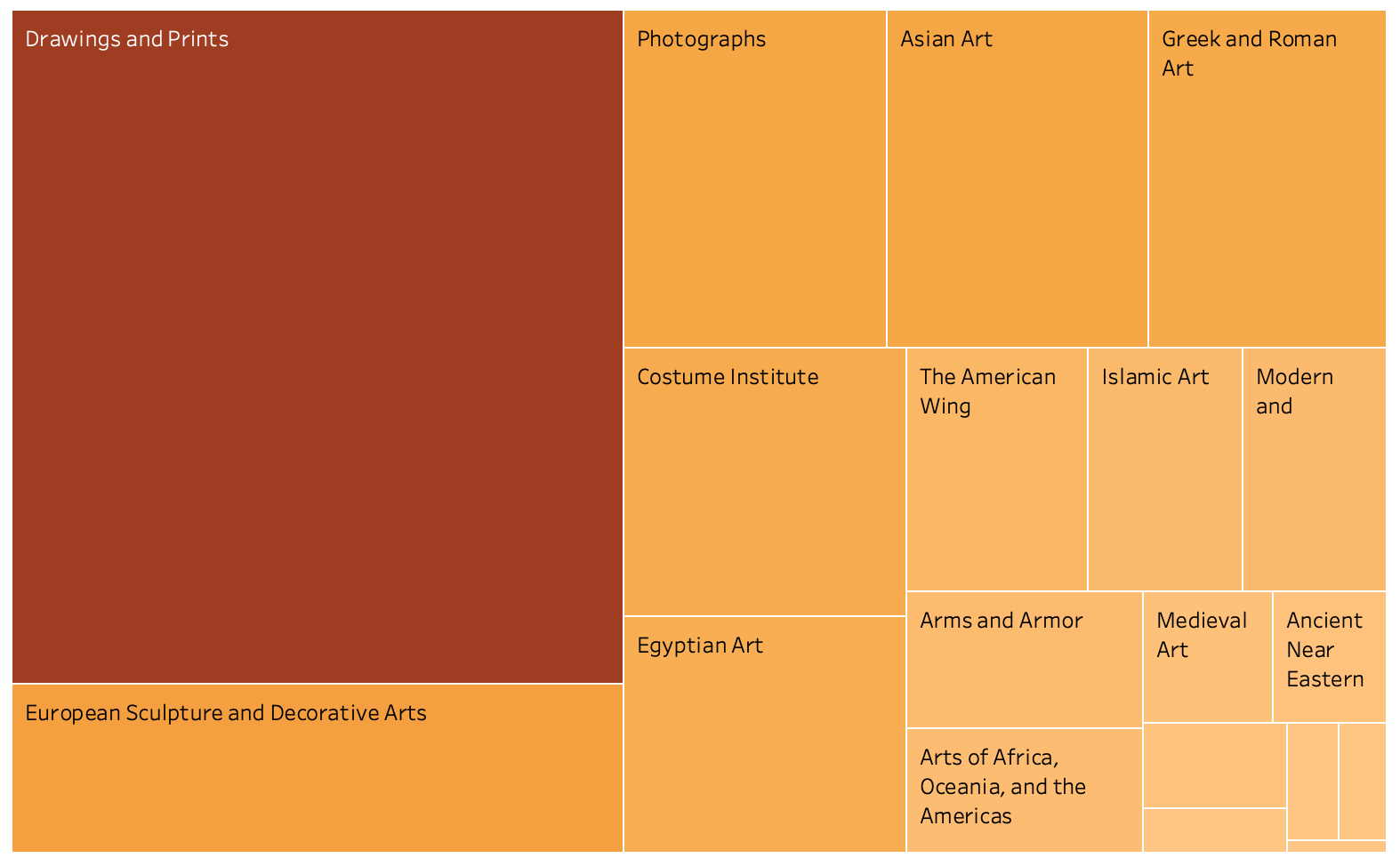

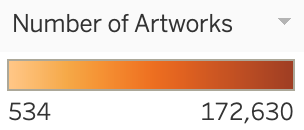
Compared with other major museums (Philadelphia Museum of Art, MFA Boston, etc.), the MET has the most artworks on paper. These artworks, such as drawings and prints are more challenging to be included in exhibitions and on display possibly due to the physical and spatial limits of the galleries and higher lighting restrictions.8
Treemap Created By Ran Peng in Tableau. Data Source: the MET's API
THE TOTAL STORAGE SPACES EQUAL TO...
= 2 Football Fields9

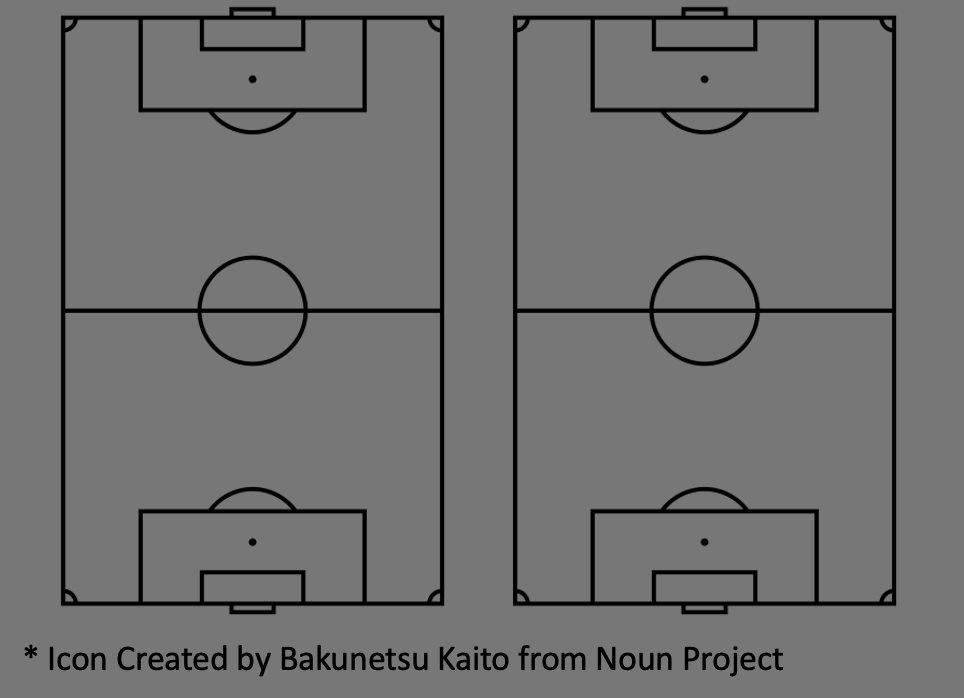
= 3.5 Small to Medium Size Museums


* calculation based on the average( 30,000 ft^2) small to medium size museum.10
= 1050 10' X 10' Individual Storage Units
which costs $156,702 per month (on average $149.24 per unit11) and cumulatively $1,880,424 over one year.
“It doesn’t benefit anyone when there are thousands, if not millions, of works of art that are languishing in storage. There is a huge capital cost that has a drag on operations.” 12


The MET first established the Gift Acceptance Policy in 2014 and amended the policy in the year 2021.13 Along with the Collection Management Policy, the Gift Review Committee was established to evaluate the acceptance of gifts and gifts of artworks that require approval from the Executive Committee.14
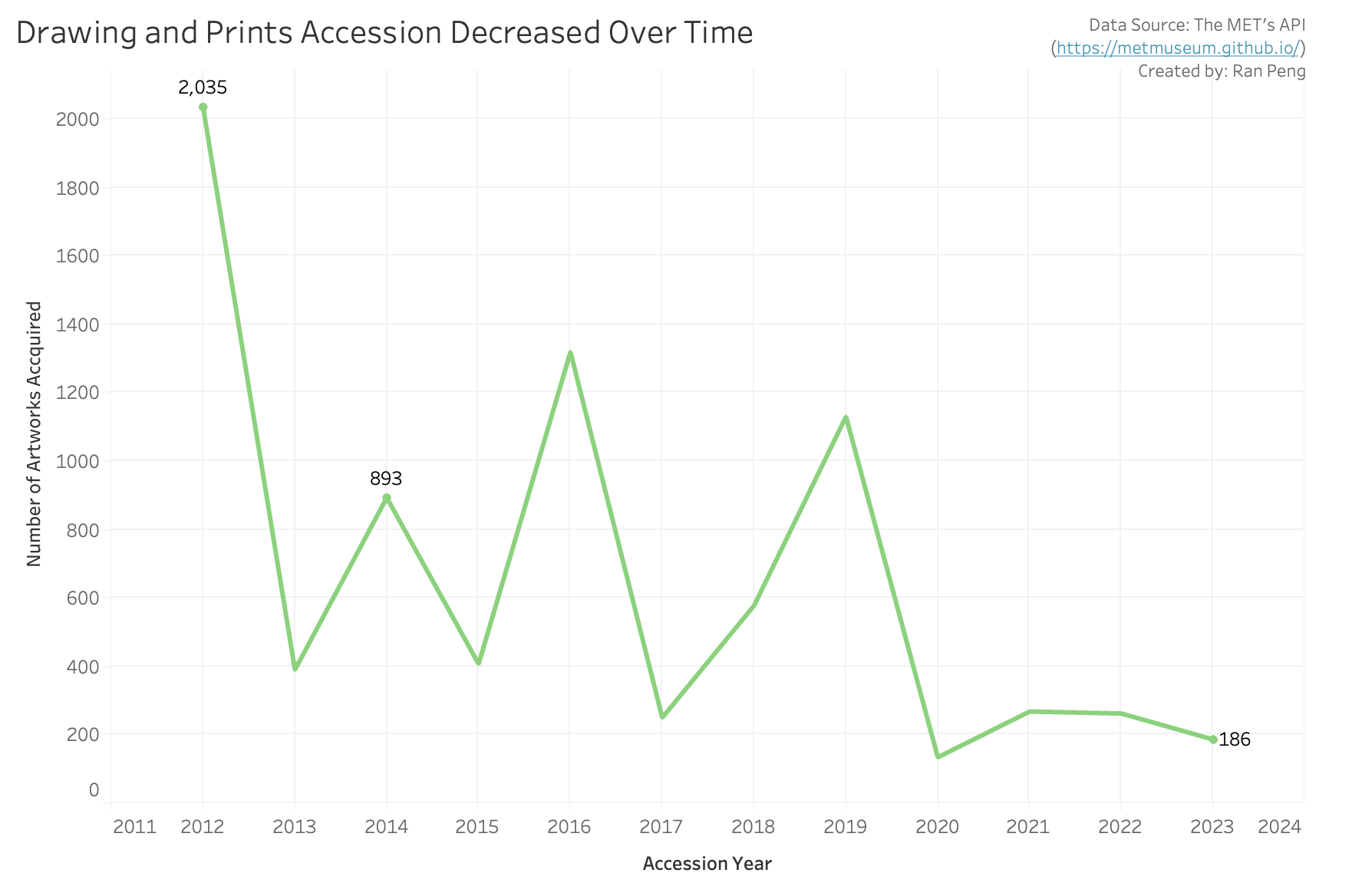
From 2012 to 2023, the MET acquired fewer drawings and prints, which decreased from 2035 items per year to 186 items per year.
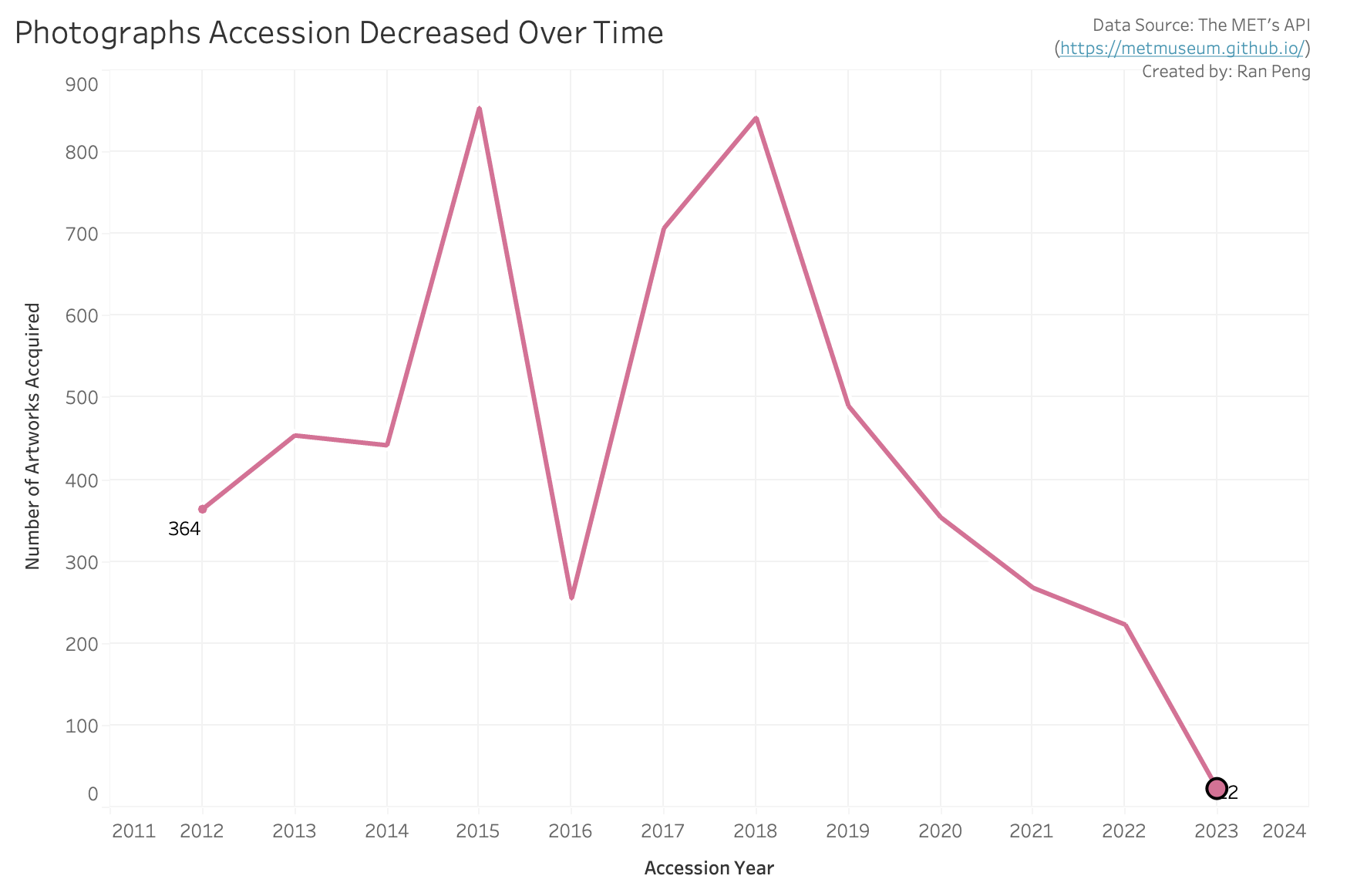
Similarly, the museum had also decreased in acquiring photographs (the second large department of The MET), which reduced from 364 items to 22 items.


Summary
It is necessary for museum directors and leaders to rethink collection management and establish proper acquisition policies. Ways include deaccessions that can facilitate a more efficient use of museums and public resources and provide financial flexibility for program development and operational support of the museums especially after the pandemic.
It can be helpful to reference the MET’s approach in improving its collection management plans and policies, especially for medium to small-size museums, which usually have tighter budgets. The following are the readings and resources that can be helpful if you are interested in learning more.
To dive into the Collection Management Topics and MET's policy examples, check out the following resources.
The MET's collection policies:
Guidance of artwork accession and development plan:
- Acquisition and Accessioning resources of the American Alliance of Museums
- Developing a collection management policy
Other Resource:
- The MET’s API
- Major Museums Collection Comparisons (article from New York Times)


Reference
1. “The Met down 1.7 Million Visitors Compared to Pre-Pandemic Level—the Biggest Drop of Any US Art Museum,” The Art Newspaper - International art news and events, March 27, 2023, https://www.theartnewspaper.com/2023/03/27/metropolitan-museum-visitors-down-1-7-million-2022.
2. “The Met Welcomed More Than 7 Million Visitors in Fiscal Year 2019 - The Metropolitan Museum of Art,” accessed December 8, 2023, https://www.metmuseum.org/press/news/2019/fy-2019-attendance.
3. “An Overview of the Museum - The Metropolitan Museum of Art,” accessed December 8, 2023, https://www.metmuseum.org/press/general-information/2010/an-overview-of-the-museum.
4. “About The Met,” The Metropolitan Museum of Art, accessed December 8, 2023, https://www.metmuseum.org/about-the-met.
5.“Collecting Practices,” The Metropolitan Museum of Art, accessed December 8, 2023, https://www.metmuseum.org/art/collecting-practices.
6. “Latest Updates,” The Metropolitan Museum of Art Collection API, accessed December 8, 2023, https://metmuseum.github.io/.
7. Robin Pogrebin, “Clean House to Survive? Museums Confront Their Crowded Basements,” The New York Times, March 10, 2019, sec. Arts, https://www.nytimes.com/interactive/2019/03/10/arts/museum-art-quiz.html#:~:text=The%20Met%20collection%20is%20particularly,other%20museums%20on%20the%20list.&text=100%25-,Collections%20have%20ballooned%20in%20the%20past%2050%20years.,of%20their%20collections%20soar%20tenfold.
8. Robin Pogrebin, “Clean House to Survive? Museums Confront Their Crowded Basements,” The New York Times, March 10, 2019, sec. Arts, https://www.nytimes.com/interactive/2019/03/10/arts/museum-art-quiz.html#:~:text=The%20Met%20collection%20is%20particularly,other%20museums%20on%20the%20list.&text=100%25-,Collections%20have%20ballooned%20in%20the%20past%2050%20years.,of%20their%20collections%20soar%20tenfold.
9. Robin Pogrebin, “Clean House to Survive? Museums Confront Their Crowded Basements,” The New York Times, March 10, 2019, sec. Arts, https://www.nytimes.com/interactive/2019/03/10/arts/museum-art-quiz.html#:~:text=The%20Met%20collection%20is%20particularly,other%20museums%20on%20the%20list.&text=100%25-,Collections%20have%20ballooned%20in%20the%20past%2050%20years.,of%20their%20collections%20soar%20tenfold.
10. Robert Hesson, “Planning The Small Museum - Space Requirements,” Northern Architecture, November 5, 2023, https://www.northernarchitecture.us/space-requirements/planning-the-small-museum.html.
11. “15 Cheap Storage Units in NYC (From $19),” Sparefoot, accessed December 8, 2023, https://www.sparefoot.com/New-York-NY-self-storage.html.
12. Robin Pogrebin, “Clean House to Survive? Museums Confront Their Crowded Basements,” The New York Times, March 10, 2019, sec. Arts, https://www.nytimes.com/interactive/2019/03/10/arts/museum-art-quiz.html#:~:text=The%20Met%20collection%20is%20particularly,other%20museums%20on%20the%20list.&text=100%25-,Collections%20have%20ballooned%20in%20the%20past%2050%20years.,of%20their%20collections%20soar%20tenfold.
13. MMA Gift Acceptance Policy_712021.pdf https://www.metmuseum.org/-/media/Files/Join%20and%20Give/Support/MMA%20Gift%20Acceptance%20Policy_712021.
14. Collection-Management-policy-10_5_23.pdf https://www.metmuseum.org/-/media/files/about-the-met/policies-and-documents/collections-management-policy/Collection-Management-policy-10_5_23.pdf.
 Built with Shorthand