
Your Contribution in India's Progress in Solar Energy
How is India's progress to meet its solar energy targets? And how can YOU support this energy transition process?

What is Renewable Energy? And why is it trending?
Various energy resources:

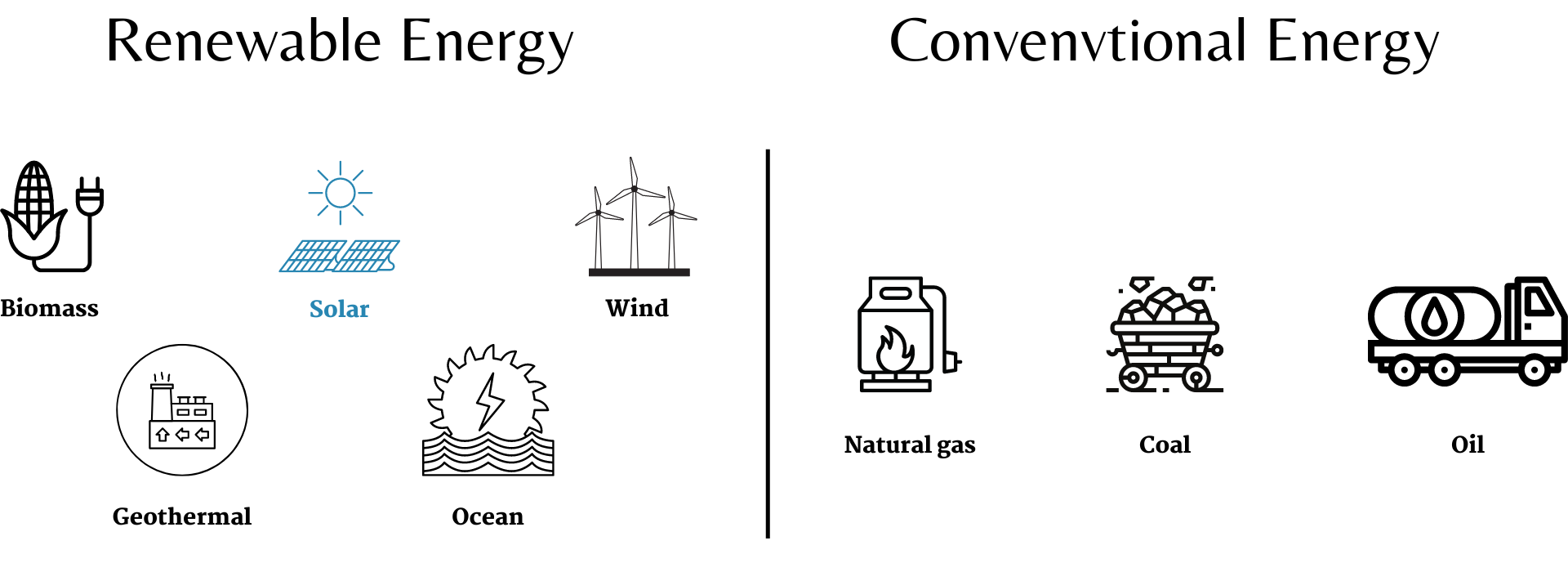
Most common renewable energy sources such as wind and solar energy are catching traction globally for several decades. They are not just less carbon intensive, but have become competitive with conventional energy production prices, and have created jobs. Still, the most important parameter to differentiate renewable energy resources and conventional ones are their lifetime greenhouse emissions in electricity generation. The figure beside compares the lifecycle emissions of some of the renewable energy sources with non-renewables. This chart gives a broader idea of by what scale renewables are better than their counterparts and conventional energy technologies.
These renewable energy technologies are generally used for electricity generation. Therefore, it is critical to converting electricity generator systems to renewable energy technologies to significantly reduce greenhouse gas emissions.
In India, 36.8% of total greenhouse gases are associated with the electricity sector.[1]
India sets the first nationwide target to promote Solar energy in 2011


India's progress through last decade:
India's progress in solar energy
India has abundant sunlight that the nation can utilize to provide electricity to its citizens. Blessed with 300 sunny days on average, India has enough sunlight to electrify every citizen of the country with solar power.[2]
Since its first announcement in 2011, the government of India has revised its targets multiple times. Because of those ambitious targets, India's progress in the last decade was phenomenal. Efforts from central and state governments have been complemented by community-driven solar plants.
India has installed more than 59 GWs of on-grid-connected solar energy capacity.[3]
But, is it enough?
India is targeting to install 175 GW of renewable energy capacity by 2022, and 100 GW of that capacity would come from solar energy. Further, this target of 100 GW installed capacity was divided into two categories: 60 GW of utility-scale plants and 40 GW of rooftop solar installed capacity by end of the year 2022.
With significant progress, the targets are expanded till 2030 and now even more ambitious. The new target of renewable energy installed capacity is revised to 450 GW.[4] Keeping the same proportion of solar energy for 2022 target (100 GW):
There should be 257.14 GW solar energy installations by 2030 to meet India's targets.
Breaking these targets further down to utility scale and rooftop solar plants:
A snapshot of India's solar energy progress till March 2021:
There is an opportunity for almost 103 GW of rooftop solar plants in Indian households.


What can YOU do as an average-income individual?


Utilize up to 40% upfront subsidy up to a system size of 3 kW, and 20% up to 10 kW under the 'Grid connected solar rooftop program'.[5]
Up to 60% upfront subsidy for on and off-grid solar irrigation pumps for agricultural customers under 'PM KUSUM' scheme.[5]
New schemes of community solar and virtual net metering are emerging in various states to cater demands of customers without accessible rooftop space.
YOU can not only contribute towards India's clean energy transition process but also theoretically make your energy bills null for more than two decades.[6],[7]
References:
[1] Ritchie, H., Roser, M., & Rosado, P. (2020, May 11). India: CO2 Country Profile. Our World in Data. Retrieved October 10, 2022, from https://ourworldindata.org/co2/country/india#total-greenhouse-gas-emissions-how-much-does-the-average-person-emit-where-do-emissions-come-from
[2] Lo, C., & GlobalData. (2011, December 20). Solar Power: India lets the sunshine in. Power Technology. Retrieved October 10, 2022, from https://www.power-technology.com/analysis/featuresolar-power-india-lets-the-sunshine-in/#:~:text=With%20a%20huge%20landmass%20and,nation%20dozens%20of%20times%20over.
[3] Physical progress. MNRE. (n.d.). Retrieved October 10, 2022, from https://mnre.gov.in/the-ministry/physical-progress
[4] Statement: India reaffirms ambitious renewable energy target at United Nations. World Resources Institute. (2021, September 25). Retrieved October 10, 2022, from https://www.wri.org/news/statement-india-reaffirms-ambitious-renewable-energy-target-united-nations
[5] Schemes: Ministry of new and renewable energy, government of India. Schemes | Ministry of New and Renewable Energy, Government of India. (n.d.). Retrieved October 10, 2022, from https://mnre.gov.in/solar/schemes
[6] Benefits of rooftop solar panels and factors that further aid their installation in India. The Economic Times. (n.d.). Retrieved October 10, 2022, from https://economictimes.indiatimes.com/small-biz/productline/power-generation/benefits-of-rooftop-solar-panels-and-factors-that-further-aid-their-installation-in-india/articleshow/69233619.cms?from=mdr
[7] National Portal for Rooftop Solar - Ministry of New and Renewable Energy. (n.d.). Retrieved October 10, 2022, from https://solarrooftop.gov.in/rooftop_calculator
 Built with Shorthand